Felix Weber · 21 September 2026
Tracing the Role of Fine Wood Particles in Modern Filtration Systems for Automotive Manufacturing Plants
Automotive manufacturing facilities rely on sophisticated air and fluid management processes to maintain clean production zones where precision components move through assembly lines, adn fine wood particles have emerged as a specialized medium in certain filtration setups over recent decades.
Historical Development of Wood-Based Filtration Media
Wood particles entered industrial filtration applications in the mid-20th century when engineers began testing lignocellulosic materials for their natural porosity and ability to capture particulate matter, while researchers in several countries documented how milled wood fractions could trap oils, metal shavings, and airborne contaminants common in vehicle production environments.
Early experiments focused on sawmill byproducts that underwent controlled grinding to achieve consistent particle sizes between 50 and 200 microns, and these fractions demonstrated measurable absorption rates when packed into filter beds or combined with synthetic binders for structural stability in high-volume exhaust streams.
Technical Integration in Automotive Plants
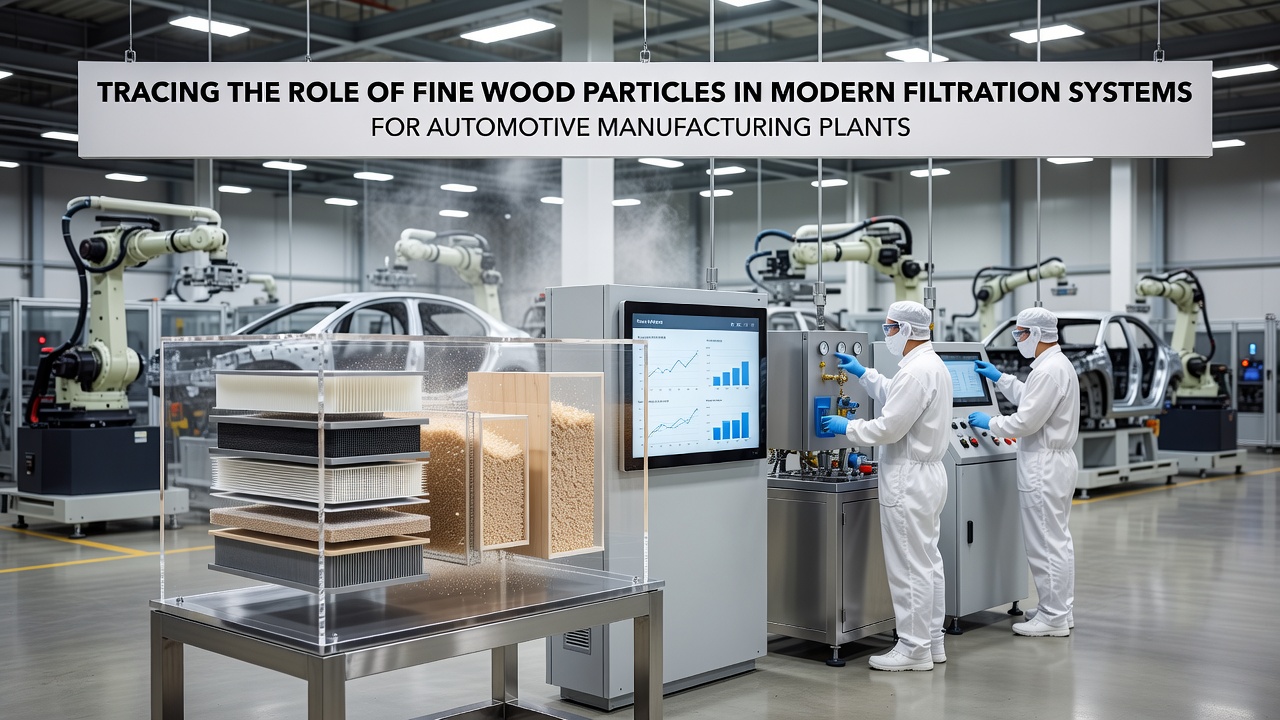
Modern automotive facilities incorporate fine wood particles into multi-stage filtration arrays that handle both ambient air purification and process water treatment, where the particles function as a renewable substrate that binds volatile organic compounds released during painting and coating operations. The material's high surface area supports microbial colonization in biofiltration units, allowing gradual breakdown of hydrocarbons without requiring frequent media replacement.
Engineers design these systems with layered configurations that place coarser wood fractions upstream to capture larger debris before finer grades address submicron aerosols, and automated monitoring tracks pressure differentials across the beds to signal when regeneration cycles become necessary.
Performance Data and Operational Metrics
Studies conducted at several North American and European plants report removal efficiencies exceeding 85 percent for certain paint overspray particulates when wood-based filters operate at optimized flow rates, according to figures compiled by the U.S. Environmental Protection Agency. Additional measurements indicate that pretreated wood particles can extend the service life of downstream HEPA stages by reducing loading rates, which lowers overall energy consumption in large-scale ventilation networks.
Data from facilities in Germany and Canada further shows that integrating these natural media into existing ductwork requires minimal retrofitting, while seasonal humidity adjustments help maintain consistent adsorption performance throughout production schedules.

Regulatory Context and Upcoming Milestones
Current environmental standards in multiple jurisdictions emphasize reductions in industrial emissions, and automotive manufacturers continue adapting filtration strategies to align with tightening thresholds on particulate and solvent releases. In September 2026, updated reporting requirements under several international frameworks are scheduled to take effect, prompting plants to document media composition and disposal pathways for wood-derived filter materials more precisely than before.
Compliance teams now track particle origin and treatment history to verify that spent media meets criteria for composting or energy recovery rather than landfill disposal, and this shift has encouraged suppliers to standardize sourcing from certified sustainable forestry operations.
Case Examples from Production Sites
One assembly plant in the Midwest United States replaced portions of its traditional activated carbon beds with engineered wood particle modules in 2023, and subsequent audits recorded a 12 percent drop in annual filter replacement costs while maintaining required air quality levels. Observers at a Japanese facility noted similar outcomes after incorporating regional cedar-derived fractions into their paint booth exhaust systems, where the aromatic properties of the wood provided incidental odor control benefits alongside mechanical filtration.
These implementations rely on precise particle size distribution and moisture content controls, because deviations can reduce flow capacity or promote premature clogging in continuous operation settings.
Material Sourcing and Sustainability Factors
Suppliers process wood particles from both softwood and hardwood species, selecting varieties based on resin content and lignin density that influence adsorption behavior in solvent-laden airstreams. Traceability programs now link batches back to specific forestry regions, allowing manufacturers to calculate carbon footprints associated with each filtration cycle.
Research institutions continue evaluating hybrid composites that blend wood particles with mineral additives to enhance durability under abrasive conditions typical of stamping and machining areas, while pilot programs test closed-loop systems that reclaim and reprocess spent media for secondary uses.
Conclusion
Fine wood particles occupy a defined niche within contemporary automotive filtration infrastructure, supported by documented performance metrics and evolving regulatory expectations that extend into 2026 and beyond. Their integration reflects ongoing efforts to balance operational efficiency with material renewability in high-throughput manufacturing environments.