Henrik Lang · 19 October 2026
Examining how suspended wood particles alter sensor calibration accuracy in automated lumber processing lines
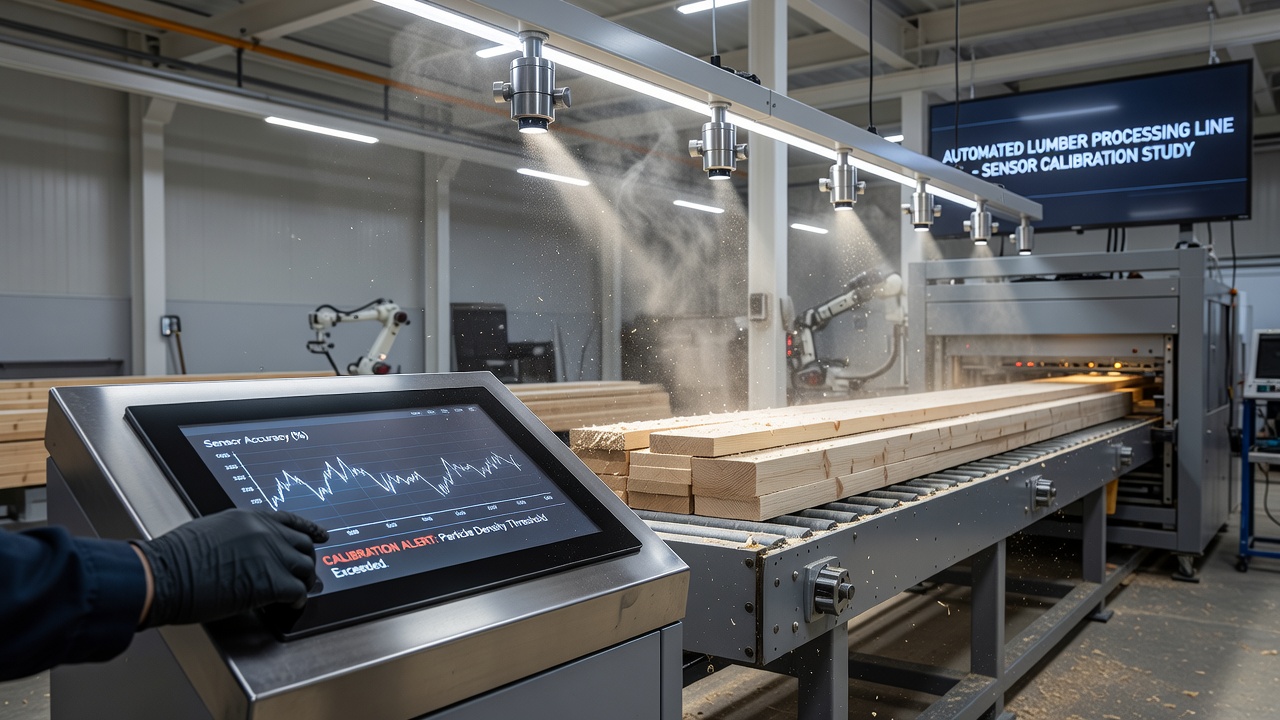
Automated lumber processing lines rely on precise sensor arrays to measure board dimensions, detect defects, and sort materials at high speeds. Suspended wood particles generated during sawing and planing operations create persistent interference that shifts calibration baselines over time. These fine particles remain airborne in enclosed mill environments, settling on optical lenses, laser emitters, and ultrasonic transducers in patterns that vary with airflow and humidity levels.
Sensor Types Most Affected by Airborne Particles
Laser triangulation sensors, which project beams to calculate distances across moving boards, experience beam scattering when particles cross the optical path. Camera-based vision systems lose contrast in images as dust accumulates on protective housings, while ultrasonic units suffer from signal attenuation caused by particle clusters in the measurement zone. Research indicates that calibration drift begins within hours of continuous operation in high-dust zones, with measurement errors increasing from initial tolerances of 0.1 millimeters to deviations exceeding 1.5 millimeters after sustained exposure.
Particle size distribution plays a central role. Particles between 5 and 50 microns remain suspended longest, creating a haze that refracts light and absorbs acoustic energy. Larger fragments settle faster yet still coat sensor surfaces during downtime periods when ventilation cycles drop. Operators in facilities across British Columbia report that morning startup routines now include extended purging cycles to clear overnight particle buildup before production resumes.
Calibration Drift Mechanisms in Practice
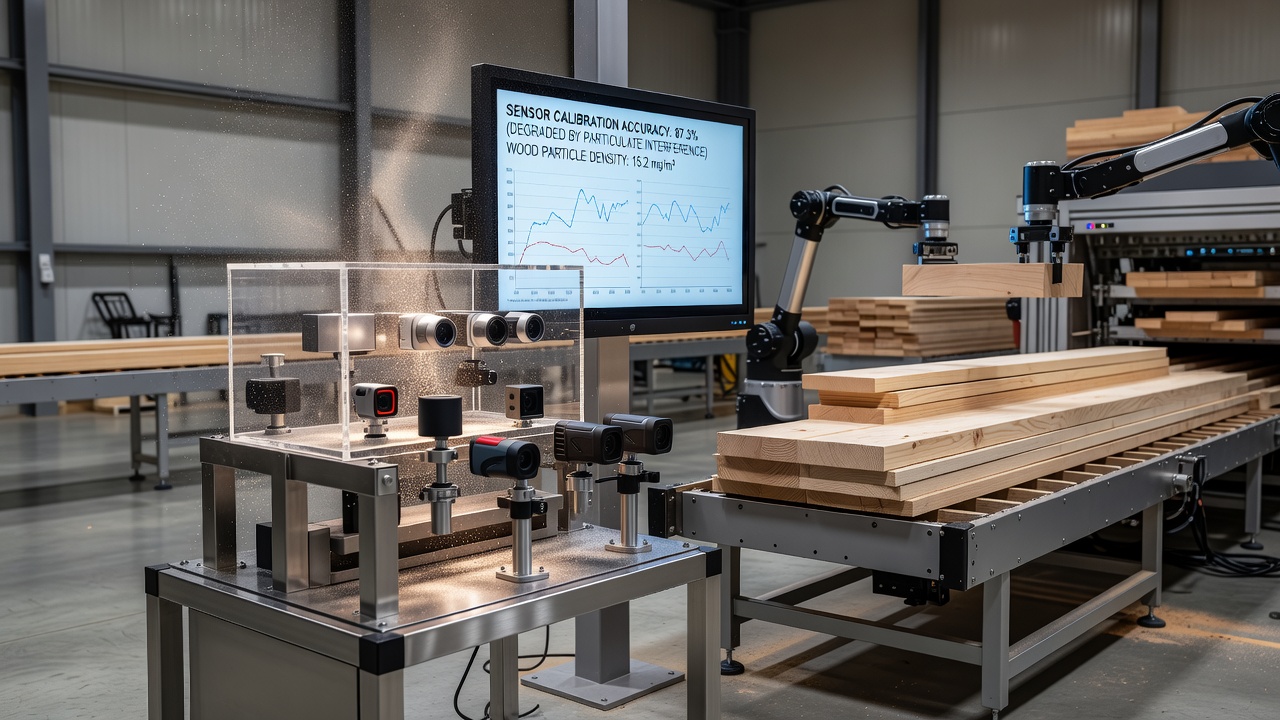
Calibration routines assume a clean optical path and stable reference surfaces. When particles adhere to emitter windows or receiver apertures, the baseline intensity readings change gradually. Systems compensate automatically at first, yet cumulative offsets push the entire measurement scale. Data from mills using similar equipment shows that recalibration intervals shorten from weekly to daily schedules once particle concentrations exceed 15 milligrams per cubic meter in the processing area.
According to a report from Natural Resources Canada, mills that integrated real-time particle monitoring with sensor arrays reduced unplanned recalibrations by 35 percent over a twelve-month period. The same study documented how seasonal humidity swings in coastal facilities accelerate particle adhesion because moisture increases static attraction between dust and sensor housings.
Environmental and Process Factors at Play
Airflow patterns inside enclosed lines determine where particles concentrate. Negative pressure zones near saw heads draw dust toward downstream sensors, whereas positive pressure curtains can push particles away from critical measurement stations. Temperature gradients between heated drying sections and cooler sorting areas further influence particle behavior, causing localized settling that varies by shift and season.
Studies from Forest and Wood Products Australia highlight that particle concentration spikes coincide with blade changes and kerf adjustments, when fresh cutting surfaces release higher volumes of fine material. Facilities that schedule sensor cleaning immediately after these maintenance events maintain tighter calibration tolerances throughout subsequent production runs.
Monitoring and Mitigation Approaches Observed in Industry
Many operations now deploy secondary particle sensors alongside primary measurement devices to track airborne loads in real time. When concentrations rise above established thresholds, automated systems trigger localized air knives or brief pauses that allow particles to clear before measurements resume. These interventions add seconds to cycle times yet preserve overall throughput by avoiding larger accuracy losses later in the process.
In October 2026, updated Canadian Standards Association guidelines for automated wood processing equipment are scheduled to include mandatory particle exposure testing during initial sensor certification. Early adopters among large-scale producers have already begun mapping particle flow paths with computational fluid dynamics models to reposition sensors away from high-concentration zones.
Conclusion
Suspended wood particles introduce measurable shifts in sensor performance that accumulate through continuous operation. Facilities tracking both particle levels and calibration status achieve more consistent output dimensions and fewer downstream quality issues. Ongoing refinements in sensor placement, cleaning protocols, and environmental controls continue to address the interaction between airborne material and measurement accuracy across lumber processing lines.